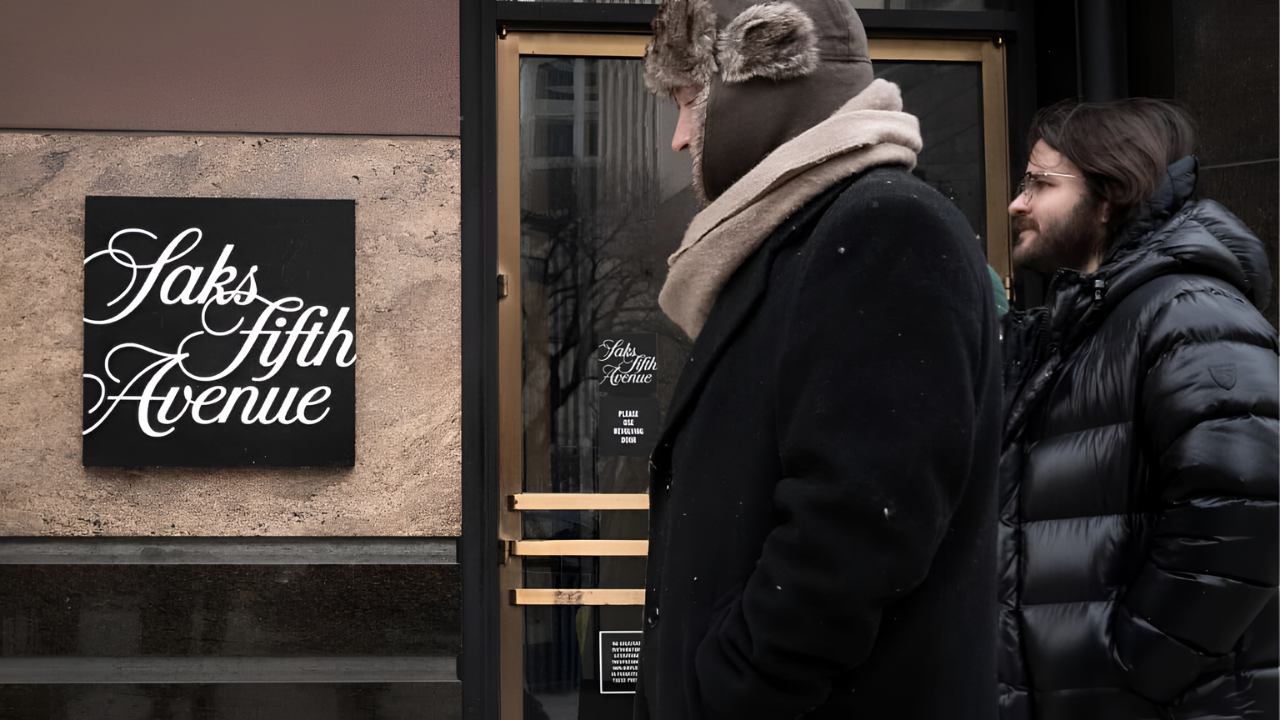
Late December 2025 marked a turning point for Saks Global. On a standard bond payment date, the company behind Saks Fifth Avenue and Neiman Marcus failed to deliver a $100 million interest payment. Bondholders, bankers, and lawyers quickly mobilized, initiating a 30-day grace period before formal default, while restructuring experts prepared for court action.
The Merger’s Swift Unraveling
Just one year prior, in December 2024, Hudson’s Bay Company’s luxury division finalized a $2.7 billion purchase of Neiman Marcus Group, forming Saks Global. The transaction secured major support, including $475 million from Amazon and investments from Salesforce. Financed heavily through debt, the merger aimed to consolidate luxury retail for long-term dominance. Instead, it accelerated a rapid downfall amid shifting market dynamics.
A Legacy Under Siege

Saks Fifth Avenue began in 1867, with its flagship store opening on New York’s Fifth Avenue in 1924, opposite St. Patrick’s Cathedral. The brand grew into an empire encompassing Bergdorf Goodman, Neiman Marcus, and Saks Off 5th, embodying American luxury for generations. Now, this historic portfolio faces an uncertain path through bankruptcy proceedings.
Market Pressures Mount
The deal unfolded as global luxury sales stalled in 2024, with younger buyers favoring experiences over products. Department stores grappled with escalating rents, labor expenses, e-commerce rivals, and brands shifting to direct sales. Saks Global pursued scale at a moment when the traditional multi-brand model was waning, squeezed by outlet trends and direct-to-consumer preferences.
Bankruptcy and Immediate Fallout
On January 14, 2026, Saks Global sought Chapter 11 protection in U.S. Bankruptcy Court in Texas. Filings listed $1–$10 billion in assets and liabilities, plus $3.4 billion in debt, largely from the acquisition. Without fresh capital, liquidation loomed. Post-merger sales dropped 13% by mid-2025, prompting earnings alerts, delayed vendor payments, and inventory shortages as brands withheld shipments.
Human and Supply Chain Toll

The crisis ensnared 17,000 workers across U.S. stores, from iconic flagships to mall outlets. Court records indicated an urgent need for $140 million to sustain wages and benefits. Suppliers suffered too: Chanel faced $136 million in unpaid claims, while Kering/Gucci and LVMH awaited tens of millions. Eroding trust led vendors to halt deliveries, exacerbating empty shelves and financial strain.
As operations faltered, Amazon wrote off its $475 million stake—linked to a planned “Saks at Amazon” platform with $900 million in projected fees—as worthless, citing contract breaches. Leadership churned: CEO Marc Metrick departed early January 2026, followed by Executive Chairman Richard Baker’s brief interim role. Geoffroy van Raemdonck, ex-Neiman Marcus CEO who navigated its prior bankruptcy, assumed control with a familiar team.
Securing Survival

Saks obtained $1.75 billion in debtor-in-possession financing, including a $1 billion loan and asset-backed facilities, approved over Amazon’s objections. This infusion supports ongoing operations but demands sacrifices: store closures, staff reductions, and a leaner structure. The company’s brands—Saks Fifth Avenue, Neiman Marcus, Bergdorf Goodman, Saks Off 5th—may restructure jointly or sell piecemeal, with trademarks potentially auctioned in liquidation.
Saks Global’s trajectory underscores vulnerabilities in luxury retail. A debt-fueled merger intended for endurance crumbled within months, leaving employees, vendors, and investors in limbo. As courts weigh outcomes, the case highlights how evolving consumer habits and operational headwinds threaten even storied names, with implications for the sector’s adaptation ahead.
Sources:
CNBC, “Saks Global files for bankruptcy protection”, January 14, 2026
Bloomberg, “Cash-Strapped Saks Skips Bond Payment Amid Talks With Creditors”, December 31, 2025
CNBC, “Saks acquisition of Neiman Marcus led to bankruptcy”, January 15, 2026
S&P Global Ratings, “S&P Global Ratings downgrades Saks Global on missed debt interest payment”, January 7, 2026
The New York Times, “Saks C.E.O. Steps Down as Company Struggles to Pay Bills”, January 2, 2026